
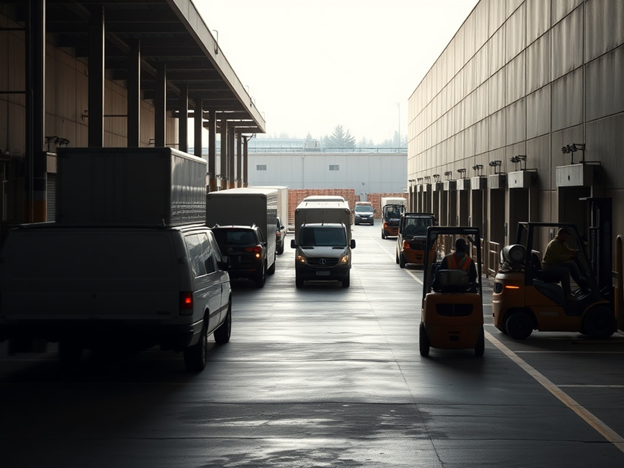
A loading bay rarely looks calm from the outside. Vehicles reverse into position, forklifts thread through narrow lanes, pallets move continuously and teams communicate in short bursts over engine noise. Yet when a dock is functioning well, there is an underlying rhythm that keeps everything flowing without conscious coordination. Dependable loading dock equipment quietly supports that rhythm, allowing people to focus on movement and timing rather than compensating for mechanical uncertainty.
What makes this choreography interesting is how little of it is formally designed. Much of the flow emerges naturally from how people adapt to their environment over time.
How Informal Routines Take Shape
Most dock efficiency comes from habits rather than handbooks. Teams learn where to stage incoming pallets so that the next movement feels intuitive. Drivers develop a sense of how much clearance they need before committing to alignment. Forklift operators time their approach based on how long door cycles usually take.
These behaviours evolve through repetition. When equipment responds predictably, people internalise timing and spacing without thinking about it consciously. That shared understanding creates smooth transitions between tasks even during busy periods.
When systems change frequently or behave inconsistently, those routines struggle to stabilise. Workers remain alert to variation rather than refining flow, which subtly slows productivity and increases mental effort.
The Hidden Cost of Small Frictions
Minor delays often go unnoticed individually. A leveller that takes slightly longer to settle, a door that hesitates before opening fully, or a sensor that triggers more cautiously than expected might only cost a few seconds each time.
Across hundreds of cycles, those seconds accumulate. More importantly, constant micro-adjustments interrupt concentration. Operators begin anticipating equipment behaviour rather than focusing solely on load handling, spacing and communication. Over long shifts, that fragmented attention contributes to fatigue and frustration even when no major issues occur.
Operational friction rarely announces itself loudly. It appears as creeping inefficiency rather than sudden breakdown.
Psychological Stability in Physical Workspaces
Predictable environments foster psychological safety. When workers trust their surroundings, they move with greater confidence and clarity. Communication improves because fewer corrections are needed mid-task. Handover points become smoother because timing feels reliable rather than uncertain.
This stability matters in physically demanding environments where cognitive load compounds fatigue. Reduced mental strain supports accuracy, patience and sustained attention across busy schedules.
Teams operating in stable systems often display higher morale and lower error rates because stress remains manageable rather than cumulative.
Designing for Invisible Performance
The most effective docks don’t feel impressive in a dramatic sense. They simply work. Equipment integrates into daily movement so seamlessly that workers rarely think about it directly.
Good design supports intuitive flow rather than forcing behavioural adaptation. Controls respond consistently. Surfaces remain predictable. Safety mechanisms operate without disrupting rhythm unnecessarily. These qualities allow people to maintain pace without sacrificing awareness or care.
Invisible performance creates space for human coordination to flourish naturally rather than being constrained by mechanical unpredictability.
When Flow Becomes Culture
Over time, a well-run dock develops its own operational culture. New team members quickly absorb established rhythms through observation rather than formal instruction. Expectations around spacing, timing and sequencing become shared knowledge.
That culture depends heavily on environmental consistency. When equipment supports reliable behaviour, habits strengthen rather than fragment. The dock becomes a system that quietly reinforces good practice rather than demanding constant correction.