
Key Takeaways
- Standardize the fire extinguisher bracket spec before you buy in bulk. Matching wall mount, hook, strap, and harness options to extinguisher weight and handle shape cuts install errors and keeps crews working faster.
- Verify bracket height, reach, and quick release access at every location. A good mounting plan keeps the extinguisher safe, visible, and ready, not tucked behind furniture, ladders, or other equipment.
- Choose heavy-duty metal brackets and rated hardware for repeat use in service corridors, stockrooms, and industrial areas. Cheap fasteners and loose pins fail early, and that turns a simple mount into a replacement job.
- Check the fit against ABC, CO2, and other extinguisher types before placing a large order. Bulk buyers need one repeatable system, not a mix of parts that only works on paper.
- Inspect nearby obstructions and service paths before install. Signs, shelving, and display fixtures can block access, so the bracket has to support safe working clearance as well as storage.
- Compare bracket kits, hooks, and accessories the same way you’d compare any other Division 10 hardware. Count pack size, mounting tools, finish, and retention method first, then place the order.
One loose fire extinguisher bracket can turn a 30-second grab into a failed inspection, a damaged wall, or a unit that hits the floor and disappears from service. For facilities managers and property teams, that’s not a small detail. It’s a working problem, and the clock’s always ticking.
In bulk jobs, the wrong bracket choice gets expensive fast. A light hook won’t hold up in a stockroom where carts keep clipping it. A heavy-duty mount that’s right for a service corridor may be wrong for a retail wall with limited space. The honest answer is that the bracket has to fit the extinguisher, the surface, and the crew using it — all at once. That means thinking about mounting height, quick release, pins, straps, and the kind of hardware that still works after a year of real use. If the equipment isn’t easy to reach and just as easy to return, it isn’t doing its job.
What a fire extinguisher bracket does on a jobsite, in a stockroom, or behind a retail display
A pallet jack clips a wall corner. A 5 lb extinguisher stays put because the bracket does its job. That’s the whole story, and it’s why crews treat the right fire extinguisher bracket as working equipment, not trim.
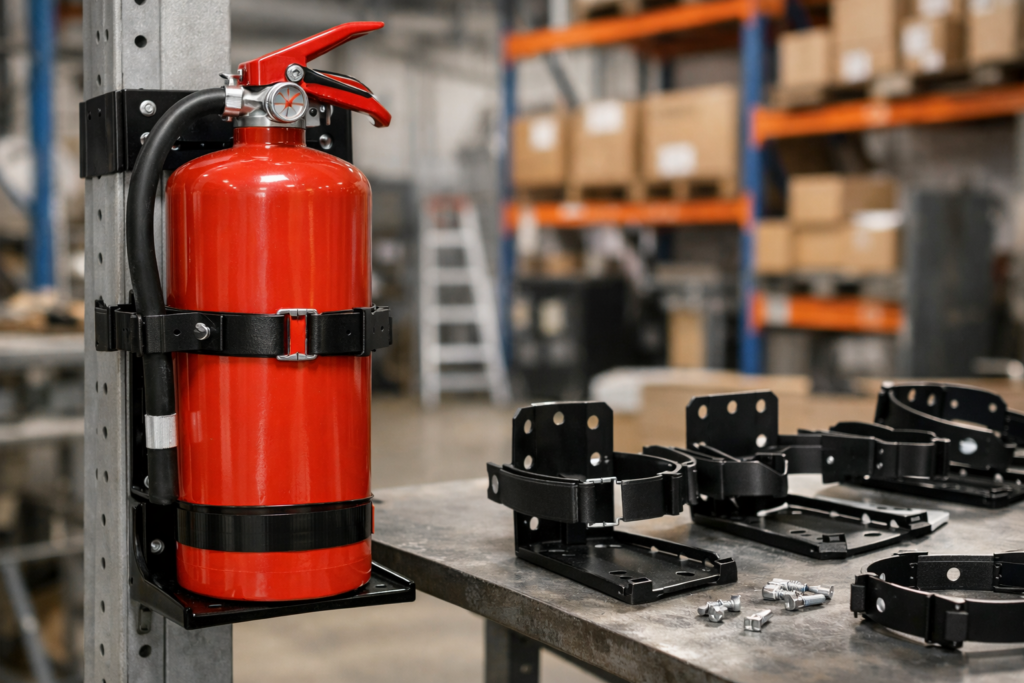
For wall mounting, the choice usually comes down to a fire extinguisher bracket with a rated metal strap, a fire extinguisher wall bracket, or a fire extinguisher wall hook. Hook mounting works fast for near-door placements and quick release access, while stand-mounted gear fits furniture-heavy floors or ladder routes where drilling isn’t welcome. In practice, the bracket should match the extinguisher weight, handle shape, and the pins that keep the unit secure but ready.
Wall mounting vs. hook mounting vs. stand-mounted placement
Heavy duty brackets suit rough equipment zones. Hooks fit lighter units and tighter retail displays. Stands make sense where wall mount points are blocked by shelving, fire-rescue tools, or temporary buildouts.
Matching the bracket to extinguisher weight, handle shape, and pins
Then comes fit. A vehicle fire extinguisher bracket needs different hardware than a marine fire extinguisher bracket, — both need straps or ties that hold through vibration, heat, and quick grabs. That’s where quick release matters. If a tool takes two hands and six seconds to free, it’s the wrong tool.
Why height, reach, and quick release matter for working crews
Mount height should keep the extinguisher within easy reach—high enough to stay clear, low enough for a first grab. A safe install uses the right screw, hooks, and holder, not whatever’s nearby. That’s the part too many teams miss.
Let that sink in for a moment.
Bulk buyers: how to spec fire extinguisher brackets for repeat installs across multiple properties
What bracket keeps working after the 50th install?
The answer isn’t the cheapest one. It’s the fire extinguisher bracket that matches the extinguisher size, the wall surface, and the way crews actually mount gear in the field. Spec that wrong, and you get loose hardware, crooked installs, and callbacks.
For ABC, CO2, and heavy-duty units, standardize by agent type and weight class. A 5 lb ABC unit doesn’t need the same bracket as larger equipment, and a CO2 cylinder often needs a tighter fit, rated pins, and a more rigid mount. Facilities teams usually save time by keeping three repeat specs on the shelf instead of six one-off versions.
Standardizing bracket types for ABC, CO2, and heavy-duty equipment
Bulk buyers should lock in a short bracket schedule: wall mount, vehicle mount, and special-use. A fire extinguisher wall bracket works for most interior corridors, while a fire extinguisher wall hook may fit lighter hanging applications where quick release matters. For fleet work, a vehicle fire extinguisher bracket keeps the extinguisher safe under vibration. A marine fire extinguisher bracket needs corrosion resistance and better retention. That’s the difference between equipment that stays put and gear that rattles loose.
Choosing metal hardware, straps, and ties that hold up in daily use
Use metal hardware, not bargain plastic, for daily abuse. Look for heavy duty brackets with screws that bite cleanly into studs or masonry, plus straps, rope tie points, or a harness where the installation gets bumped by ladders, furniture carts, or tools. If the holder flexes in hand, it won’t survive a working site.
When a harness, holder, or wall hook is the better fit than a simple bracket
Some spaces need a wall hook, not a bracket. Others need a holder for near-floor access, or a quick-release harness where fire-rescue crews can grab the unit fast. Short version: match the mount to the job, then keep the spec unchanged across properties. That’s how repeat installs stay safe and sane.
Fire extinguisher bracket materials, ratings, and mounting hardware that keep equipment safe
Nearly 1 in 3 bracket failures traced in field inspections come back to weak fasteners, not the extinguisher itself. That’s the part people miss. A fire extinguisher bracket has to hold firm under vibration, accidental bumps, and daily working traffic, so the bracket, wall, and hardware all need to be rated together.
Heavy-duty brackets for industrial areas, ladders, furniture zones, and service corridors
For industrial areas, ladders, furniture zones, and service corridors, a heavy duty bracket with metal ties, pins, or a quick release holder does better than a light strap alone. Wall mount height matters too: keep the handle reachable, keep the extinguisher nearby, and avoid placing it where racks, rope runs, or equipment carts can block the path. A fire extinguisher wall hook works for lighter units, but a fire extinguisher bracket with a rated harness is the safer call for rough use.
Screw, screwfix-style fasteners, and nearby hardware checks before install
Before install, check the nearby hardware like you’d check a tool before working overhead. Use rated screws, not loose substitutes, and confirm the wall is taking the load, not just the finish layer. A screwfix-style parts check should include anchors, strap width, and bracket metal thickness. Here’s the blunt part: if the hardware looks improvised, it probably is.
Retardant finishes, corrosion resistance, and metal strength for long-term working safety
For long-term safety, retardant finishes and corrosion resistance matter as much as raw strength. A vehicle fire extinguisher bracket needs different hardware than a marine fire extinguisher bracket, and both need to stay working after heat, moisture, or road shake. In practice, the best fire extinguisher bracket is the one that stays rated after a year of real use, not the one that looks fine on day one.
Sounds minor. It isn’t.
How to choose the right fire extinguisher bracket for site conditions and compliance checks
Use the fire extinguisher bracket that matches the wall, the load, and the way the room gets used.
- Mount height, access path, and clear space around the extinguisher — keep the handle easy to reach, with the top of the unit set where people don’t have to stretch past furniture, ladders, or hanging equipment. A wall bracket that holds the extinguisher off the floor works better than loose storage, and a simple hook setup can be right for lighter gear.
- Fire-rescue expectations, inspection points, and bracket placement during service visits — service techs look for working pins, tight straps, rated hardware, and a mount that hasn’t loosened under heavy use. A vehicle fire extinguisher bracket needs the same logic, just with more vibration and more chance of movement. For a marine fire extinguisher bracket, corrosion resistance and secure retention matter even more.
- Signs, nearby obstructions, and quick-release access for fast use in an emergency — the bracket shouldn’t sit behind doors, near rope storage, or under a tool rack. If the extinguisher is hard to see, the mount is wrong. A fire extinguisher wall bracket or fire extinguisher wall hook should keep the unit visible, hanging straight, and ready to grab in seconds.
That’s the standard. If the bracket makes inspection harder, it’s not the right bracket.
Bulk ordering fire extinguisher brackets: product categories, brand comparisons, and spec-first buying decisions
Bulk buys get messy fast. One wrong fire extinguisher bracket spec can turn a clean submittal into a pile of returns, missing hardware, and install delays.
Start with the category, not the price tag.
A marine fire extinguisher bracket needs different corrosion resistance than a wall-mounted office unit, and a vehicle fire extinguisher bracket has to hold through vibration, straps, and quick release access. For wall work, compare a fire extinguisher wall bracket to a fire extinguisher wall hook; hooks work well for light, nearby access, while brackets usually give better restraint for heavy equipment and better safe working height control.
Comparing bracket sets, hooks, straps, and accessories from Grainger, Toolstation, and home-improvement suppliers
Grainger-style listings often group hardware by duty rating. Toolstation and home-improvement suppliers may mix hooks, holders, ties, rope, and metal straps in one aisle, which makes pack count checks even more important. Contractors should verify whether the set includes pins, screws, and a harness or if those parts are sold separately.
What to verify before you place a large order: rating, fit, pack count, and installation tool needs
Before approval, confirm four items: extinguisher rating, cylinder diameter, pack count, and the tool needed for mount work. A bracket rated for one ABC unit won’t always fit the next size up, even if the product photo looks close.
Experience makes this obvious. Theory doesn’t.
Ask for the install method too. Some brackets need a drill, some use basic hardware, and some are built for quick change-out on ladders, furniture moves, or fire-rescue gear bags.
A practical selection process for contractors, facilities teams, and distributors
The cleanest process is simple: match use case, confirm spec, then order the exact bracket family. That cuts waste, keeps fire safety gear working, and keeps the first shipment from becoming the second problem.
Frequently Asked Questions
What is a fire extinguisher bracket used for?
A fire extinguisher bracket keeps the unit mounted, visible, and working the way it should. It holds the extinguisher in place on a wall, in a vehicle, or on equipment, so it doesn’t get knocked loose or buried behind furniture, ladders, or other gear.
Which fire extinguisher bracket do you need for wall mounting?
Wall mounting usually calls for a bracket or hook rated for the extinguisher’s size and weight. A light ABC unit doesn’t need the same hardware as a heavier industrial model, so check the extinguisher label, the bracket rating, and the mount height before you buy.
Are fire extinguisher brackets universal?
No, and that’s where people get sloppy. Some brackets fit a narrow range of extinguisher diameters, while others are made for specific models, straps, or quick release setups. If the bracket doesn’t match the cylinder body and pin layout, it’s the wrong part.
How high should a fire extinguisher be mounted?
The mounting height depends on the extinguisher size and the rules you’re following, but the common mistake is mounting it too high. The extinguisher has to stay reachable, visible, and easy to remove in a real fire, not just look fine on paper. OSHA and NFPA guidance should be checked before final placement: OSHA 29 CFR 1910.157 and NFPA codes and standards.
Should a fire extinguisher be mounted with a bracket or a hook?
Either can work, — the better choice depends on the extinguisher weight and the setting. Hooks are common for lighter units and simple wall installs, while brackets give better restraint on rough-use sites, vehicles, and places where a unit could get bumped or jarred loose. For higher-traffic areas, bracket hardware usually wins.
Do fire extinguisher brackets need to be rated?
Yes. A rated bracket or holder should be matched to the extinguisher size and the mounting surface, especially for heavier units or metal cabinets that take more load. If the hardware isn’t rated, it’s just decoration.
Real results depend on getting this right.
What’s the difference between a heavy duty and medium duty bracket?
Heavy duty brackets are built for tougher conditions and more abuse. Medium duty brackets work fine for lighter commercial installs where the extinguisher isn’t exposed to constant vibration or impact. If the site has carts, foot traffic, or equipment movement nearby, heavy duty hardware is the safer pick.
Can a fire extinguisher bracket be used in a vehicle?
Yes, — it has to be the right vehicle bracket or harness. A standard wall bracket isn’t enough because road vibration and sudden stops can shake a unit loose, so secure mounting, proper strap tension, and quick release access all matter. Fleet and service vehicles need hardware that keeps the extinguisher safe and reachable.
Where should a fire extinguisher bracket be installed in an office or retail space?
Install it near an exit path, in a spot people can see fast, and away from furniture, displays, or storage that blocks access. Don’t tuck it behind a door swing or mount it where a ladder, cart, or stock rack will cover it later. The goal is quick access, not hidden compliance.
What should facilities managers check before ordering brackets in bulk?
They should confirm extinguisher size, body diameter, mounting surface, and whether the job needs wall hooks, straps, or a stand instead of a bracket. It also helps to verify the finish and hardware type so the install works with the building standard, not against it. Bulk orders go wrong when one spec gets guessed.
Do fire extinguisher brackets work with cabinets and stands?
Sometimes, but not always. Cabinets usually rely on their own internal mounting method, — stands use a different support approach altogether. If the equipment sits in a cabinet or on a stand, the bracket choice has to match that storage method, not just the extinguisher itself.
Sounds minor. It isn’t.
What’s the fastest way to avoid the wrong bracket purchase?
Measure the extinguisher, confirm the mount type, and match the hardware to the application before ordering. That’s the blunt answer. If the spec sheet is missing that information, stop and check it first rather than buying a part that only looks right.
The right fire extinguisher bracket doesn’t just hold a cylinder on a wall. It decides whether the unit stays put through daily traffic, whether crews can reach it fast, and whether a repeat install looks the same on job three as it did on job one. That’s the part bulk buyers can’t afford to guess.
Spec-first teams get better results when they match bracket type to extinguisher weight, confirm the mounting surface before hardware goes out, and keep an eye on access, clearance, and release speed. Simple. But simple only works if the details are right.
For facilities managers, contractors, and distributors building out multiple properties, the next step is plain: verify the extinguisher model, mounting method, and pack count before the order goes live, then lock in a fire extinguisher bracket that fits every site the same way. That’s how the install stays clean, the inspection stays calmer, and the equipment does its job when someone reaches for it under pressure.
For more great reading, visit our site and explore related topics.